
🌍 Introduction: When Borders Burn
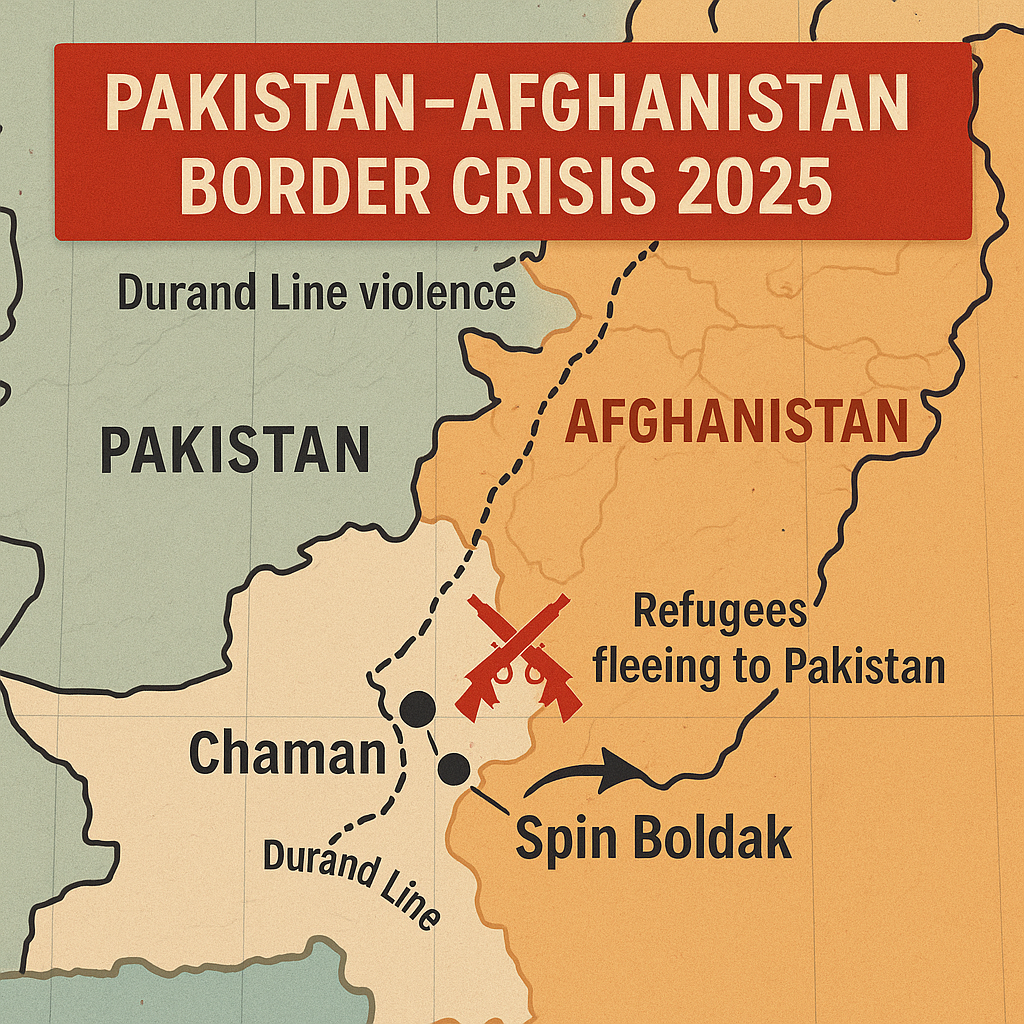
In the first week of November 2025, the world watched a familiar story unfold along one of Asia’s most volatile frontiers — the Durand Line, the 2,640-km border dividing Pakistan and Afghanistan.
Ceasefire talks collapsed in Istanbul. Gunfire echoed near Chaman and Spin Boldak. Civilians were killed. Refugees pushed back across the frontier. And both sides blamed each other for starting it.
If this sounds like history repeating itself — it is. But this time, the stakes are higher.
⚔️ The Story So Far
The latest Pakistan–Afghanistan tension began as a diplomatic deadlock.
Negotiators from Islamabad and Kabul met in Istanbul to revive cross-border peace, but talks collapsed without agreement. Pakistan’s Defence Minister Khawaja Asif publicly warned, “If talks fail, only war remains.”
Within days, border skirmishes erupted. Afghan officials reported civilian deaths, while Pakistan accused Afghan forces of initiating fire. The Tehreek-e-Taliban Pakistan (TTP) — a militant group long linked with attacks inside Pakistan — again became the center of blame.
Pakistan claims the TTP operates from Afghan soil; the Taliban government in Kabul denies it, insisting, “It’s your internal problem.”
Meanwhile, Pakistan’s mass deportation of Afghan refugees, many of whom have lived in the country for decades, has further poisoned relations.
🚧 The Root Causes Behind the Clash
1. A Border That Never Healed
The Durand Line, drawn by the British in 1893, has always been controversial. It cuts through Pashtun tribal lands, dividing families and communities.
For many Afghans, it’s an artificial colonial scar; for Pakistan, it’s a legally recognized boundary. This disagreement fuels nationalism and resentment on both sides.
2. Militants Without Borders
Groups like TTP thrive in mountainous regions where both states have limited control. When an attack happens, each side accuses the other of sheltering terrorists.
This blame loop has derailed almost every peace effort in the past two decades.
3. Weaponizing Refugees
Pakistan has hosted millions of Afghan refugees for decades. But now, it’s pushing thousands back across the border, citing security concerns.
Afghan officials call this “weaponizing refugees” — using human lives as a political tool.
4. Two Governments, One Army
Inside Pakistan, there’s also a power struggle. Civilian leaders negotiate peace, but the real authority often lies with the military establishment in Rawalpindi.
When the army and the government speak with different voices, agreements collapse — just as they did this time.
5. The American Factor
Observers note that the U.S. has quietly renewed military aid to Pakistan, including $450 million for F-16 upgrades. Why now? Analysts suggest Washington wants Islamabad’s cooperation to contain instability around Iran and Afghanistan.
In geopolitics, money moves faster than peace.
🕊️ The Human Cost: Civilians Caught in the Crossfire
Behind every headline about “border tensions” are real people — farmers, traders, children.
Border closures mean no food trucks, no medicine, and no school supplies.
Families that lived in Pakistan for generations now find themselves homeless in a country they barely know.
The violence along the Durand Line isn’t just about power — it’s about people’s survival.
🔭 Astrological Insight: The Mars–Saturn Conflict
In Vedic symbolism, this crisis mirrors a Mars–Saturn conflict — anger colliding with rigid authority.
Mars represents war, impatience, and direct action. Saturn represents structure, control, and limitation.
When these two clash, you get conflict born of frustration — powerful forces pushing against immovable walls.
Add the Rahu–Ketu axis (illusion and past karma), and the mix becomes volatile: nationalism, fear, and betrayal dominate collective thinking.
In short, the stars echo what geopolitics shows — this is a time of ego-driven escalation.
Only restraint and structure (Saturn’s energy) can calm Mars’ fire.
🧭 What Needs to Happen Next
Peace here won’t come from slogans; it needs practical containment.
Here’s what experts and humanitarian agencies are urging:
✅ Neutral Monitors: Deploy independent observers along the Durand Line to verify ceasefire violations.
✅ Humanitarian Corridors: Keep crossings open for refugees, food, and aid, even during military tension.
✅ Crisis Hotlines: Establish real-time communication channels between field commanders to avoid misfire incidents.
✅ TTP Control: Joint intelligence operations to dismantle cross-border militant safe havens.
✅ International Accountability: Pressure from UN, Qatar, Turkey, and others to enforce peace agreements on both military and political levels.
🧩 Final Thoughts
The Pakistan–Afghanistan conflict is not just a story of two nations — it’s a mirror reflecting decades of mistrust, proxy wars, and wounded pride.
Whether you look at it through the lens of geopolitics or astrology, the message is clear:
🔥 Unchecked aggression destroys its host first.
If Mars (conflict) rules the moment, only Saturn (discipline and wisdom) can restore balance.
Both nations — and the wider world — must remember: wars start at borders but end in homes.
Author’s Note:
This article is a factual and interpretive overview of the ongoing Pakistan–Afghanistan tension (as of November 2025), written for educational and analytical purposes.











Leave a Reply