
INTRODUCTION
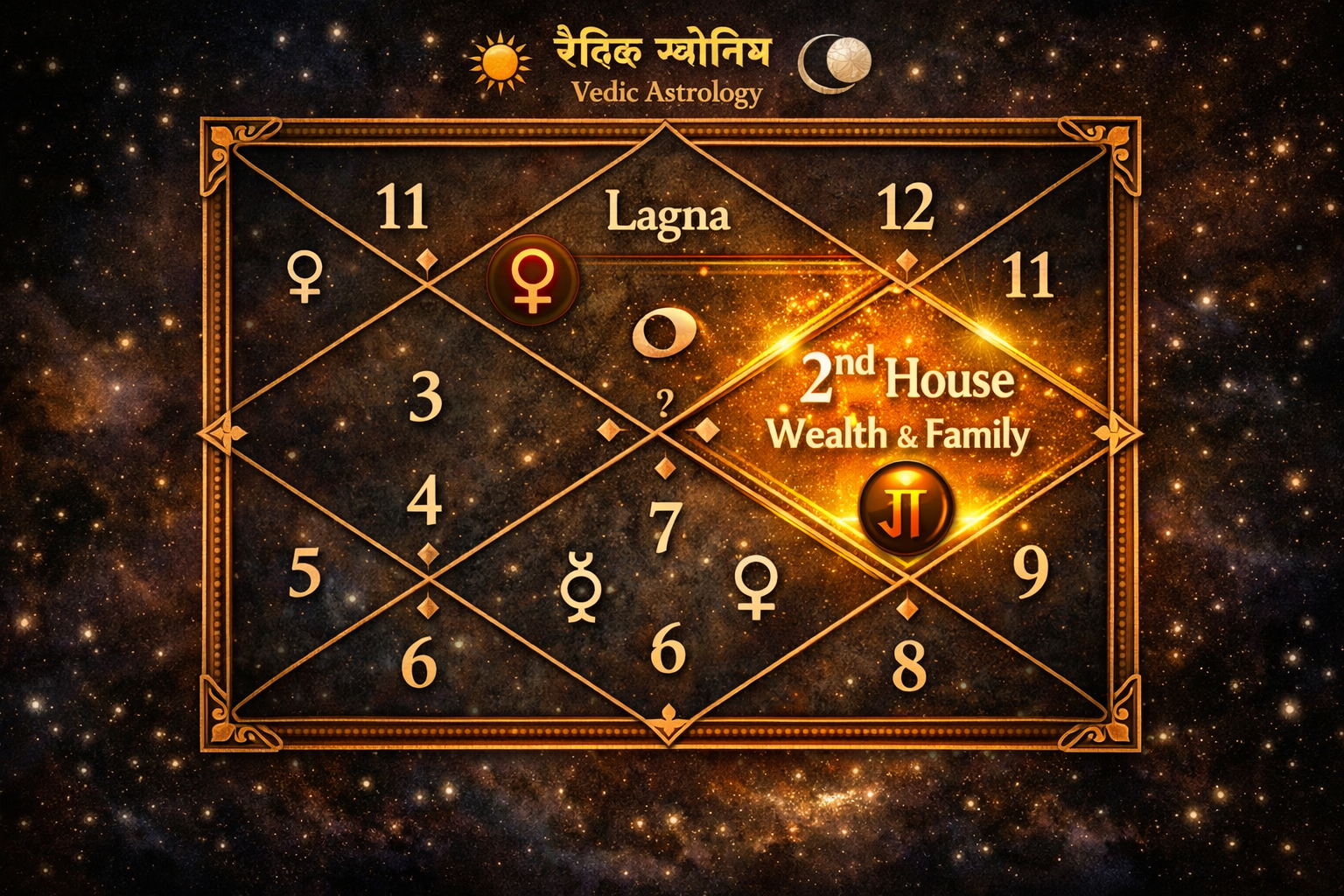
In advanced Vedic astrology, the 2nd Lord in different houses (Dhana Bhava Adhipati) functions not merely as an indicator of wealth, but as a primary karaka for accumulated karma, family sanskaras, speech-based karma, and value systems carried forward from previous births. Its placement across the twelve houses reveals how resources are generated, preserved, lost, or transformed, and how financial karma interacts with dharma, artha, kama, and moksha.
This analysis assumes the reader understands lordship principles, functional benefic/malefic status, house significations, and dasha-based activation.
Core Functional Meaning of the 2nd Lord
At an advanced level, the 2nd Lord signifies:
-
Stored karmic results (Purva Punya) manifesting as wealth or deprivation
-
Vak Shakti (speech potency and karmic impact of words)
-
Continuity of family lineage karma
-
Ability to retain gains, not merely earn them
-
Relationship between self-worth and material security
Its placement must always be judged in relation to:
-
The Lagna and Lagna Lord
-
11th Lord (income realization)
-
Dhana yogas and Artha trikonas
-
Maraka potential, especially in certain dashas
In the 1st House (Lagna Bhava)
When the 2nd Lord occupies the Ascendant:
-
Wealth karma becomes self-centric and identity-driven
-
The native’s physical body and personality carry ancestral karmic imprints
-
Strong tendency toward self-earned wealth
Advanced Note:
If the 2nd Lord is functionally benefic and strong, this placement forms Dhana Yoga through Lagna association. If afflicted, ego-driven financial decisions and speech-based conflicts arise.
In the 2nd House (Swakshetra Effect)
This placement reinforces the natural domain of the planet:
-
Strong continuity of family wealth
-
Speech becomes a tool for wealth creation or preservation
-
Stable food habits and value systems
Advanced Note:
Affliction here can indicate family karmic debts, ancestral disputes, or hereditary financial burdens.
In the 3rd House (Upachaya Interaction)
This placement channels wealth through:
-
Self-effort (Parakrama)
-
Communication, media, writing, sales, or negotiation
-
Gradual financial growth through initiative
Advanced Note:
Results improve with age. Benefic aspects can produce skill-based income streams, while malefic influence creates unstable but aggressive earning patterns.
In the 4th House (Sukha-Artha Axis)
Here, accumulated wealth ties into:
-
Property, land, vehicles, and fixed assets
-
Emotional security derived from material stability
-
Mother’s family wealth or domestic inheritance
Advanced Note:
If afflicted, the native may experience emotional dependency on wealth or property disputes.
2nd Lord in the 5th House (Purva Punya Connection)
A refined placement indicating:
-
Wealth derived from intelligence, speculation, education, or creativity
-
Activation of past-life merit
-
Financial uplift after childbirth or educational milestones
Advanced Note:
Strong placement forms Lakshmi Yoga–type effects, but affliction leads to losses via speculation.
In the 6th House (Rina Bhava)
A karmically demanding placement:
-
Wealth gained through service, litigation, health sectors, or competition
-
Indicates financial karma involving debts and repayment
-
Earnings increase through discipline and adversity
Advanced Note:
This placement demands careful dasha analysis, as wealth often comes after overcoming enemies or debts.
In the 7th House (Yuvati Bhava)
Wealth becomes relational:
-
Financial gains via spouse, business partnerships, or public dealings
-
Family wealth expands post-marriage
Advanced Note:
Affliction can produce dependency, marital financial conflict, or loss through partnerships.
2nd Lord in the 8th House (Randhra Bhava)
This is a deeply karmic placement:
-
Wealth through inheritance, insurance, research, or hidden sources
-
Sudden financial reversals or gains
-
Family secrets regarding money
Advanced Note:
If well-aspected, this placement can produce unexpected windfalls during favorable dashas.2nd Lord in different houses
In the 9th House (Dharma Trikona)
One of the most auspicious placements:
-
Wealth aligned with ethics, faith, and higher knowledge
-
Support from father, gurus, or institutions
-
Strong moral framework around money
Advanced Note:
Forms Dharma–Artha Yoga, often leading to grace-based prosperity.
In the 10th House (Karma Bhava)
A high-impact placement:
-
Wealth through profession, authority, or public role
-
Strong alignment between career and income
-
Reputation directly affects financial standing
Advanced Note:
Affliction can cause public financial controversies or work-driven material obsession.
In the 11th House (Labha Bhava)
One of the strongest wealth placements:
-
Multiple income streams
-
Powerful networks and social gains
-
Fulfillment of material desires
Advanced Note:
Requires ethical balance; excess greed can damage long-term gains.
In the 12th House (Vyaya Bhava)
A spiritually transformative placement:
-
Wealth connected to foreign lands, charity, or spiritual institutions
-
High expenditure patterns
-
Weak retention capacity
Advanced Note:
In higher charts, this placement supports moksha-oriented detachment from wealth.2nd Lord in different houses
Advanced Modifiers to Always Apply
Final results depend on:
-
Planetary dignity (Uccha, Neecha, Swakshetra)
-
Conjunctions and Graha Yuddha
-
Navamsa strength of the 2nd Lord
-
Dasha–Antardasha activation
-
Interaction with 11th and 5th Lords
-
Malefic aspects from Saturn, Mars, Rahu, or Ketu
Conclusion for Advanced Practitioners
The 2nd Lord is not merely a wealth indicator—it is a karmic ledger of value retention, ancestral patterns, and speech-based destiny. Its house placement reveals how money behaves, not just how it is earned.
A refined analysis of the 2nd Lord is essential for:
-
Accurate wealth prediction
-
Understanding inheritance karma
-
Timing financial peaks and collapses
-
Counseling clients on value alignment
FAQ: 2nd Lord in Different Houses (Vedic Astrology)
What does the 2nd Lord represent in Vedic astrology?
In Vedic astrology, the 2nd Lord represents wealth accumulation, family values, speech, food habits, and stored karma. It shows how money is saved and sustained rather than how it is earned. The placement of the 2nd Lord in different houses reveals financial stability, inheritance patterns, and value systems.
Which is the best house placement for the 2nd Lord?
The 11th house is considered the best placement for the 2nd Lord in Vedic astrology because it supports continuous income and fulfillment of desires.
Other highly favorable houses include the 2nd house (own house), 9th house (fortune), and 10th house (career and authority).
Does a strong 2nd Lord always give wealth?
No, a strong 2nd Lord alone does not guarantee wealth.
For wealth to manifest, the 2nd Lord must connect with the 11th house, favorable dashas, and supportive planets. Without income support, the 2nd Lord may only indicate strong values and speech ability.
Is the 2nd Lord a Maraka planet?
Yes, the 2nd Lord is a primary Maraka (death-inflicting) planet in Vedic astrology. During its dasha or antardasha, it can produce health challenges or financial crises if afflicted. When strong and benefic, it gives wealth and stability.
How does the 2nd Lord affect speech and communication?
The 2nd Lord governs speech (Vak Shakti).
-
A strong 2nd Lord gives persuasive, authoritative speech
-
An afflicted 2nd Lord can cause financial loss through words, arguments, or reputation damage
This is especially important for careers involving communication.
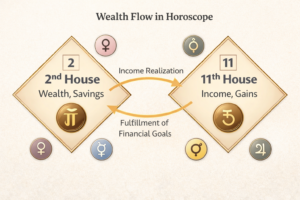
What is the difference between the 2nd Lord and the 11th Lord?
-
2nd Lord → savings, wealth retention, family assets
-
11th Lord → income, profits, desire fulfillment
In wealth prediction, both must work together. Strong income without a strong 2nd Lord leads to poor savings.
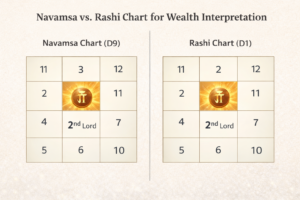
How important is the Navamsa placement of the 2nd Lord?
The Navamsa placement of the 2nd Lord is extremely important.
It shows the maturity and sustainability of wealth:
-
Strong Navamsa = long-term financial stability
-
Weak Navamsa = temporary or fluctuating wealth
Yoast Tip: This improves content depth, a key ranking factor.
Does the 2nd Lord indicate inheritance?
Yes, inheritance is indicated when the 2nd Lord connects with the 8th house, 4th house, or 9th house.
However, inheritance must be confirmed through dasha timing and family lineage indicators.
Can a weak 2nd Lord still give wealth?
Yes, but wealth usually comes through:
-
Hard work (3rd or 6th house placement)
-
Foreign sources (12th house)
-
Sudden gains (8th house)
Such natives often earn money but struggle to retain it.
How does the 2nd Lord affect food habits and health?
The 2nd Lord governs food intake, eating discipline, throat, teeth, and digestion.
Affliction may cause unhealthy eating patterns or speech-related health issues, especially during the 2nd Lord’s dasha.
Which dasha gives wealth promised by the 2nd Lord?
Wealth manifests during:
-
Dasha of the 2nd Lord
-
Dasha of the 11th Lord
-
Dasha of planets connected to both
Maximum results occur when dasha and transit activate the 2nd–11th axis.
Is the 2nd Lord more important than Dhana Yoga?
Yes.
Without a strong 2nd Lord, even powerful Dhana Yogas fail to give lasting wealth. The 2nd Lord decides whether money stays or leaves.










Leave a Reply